
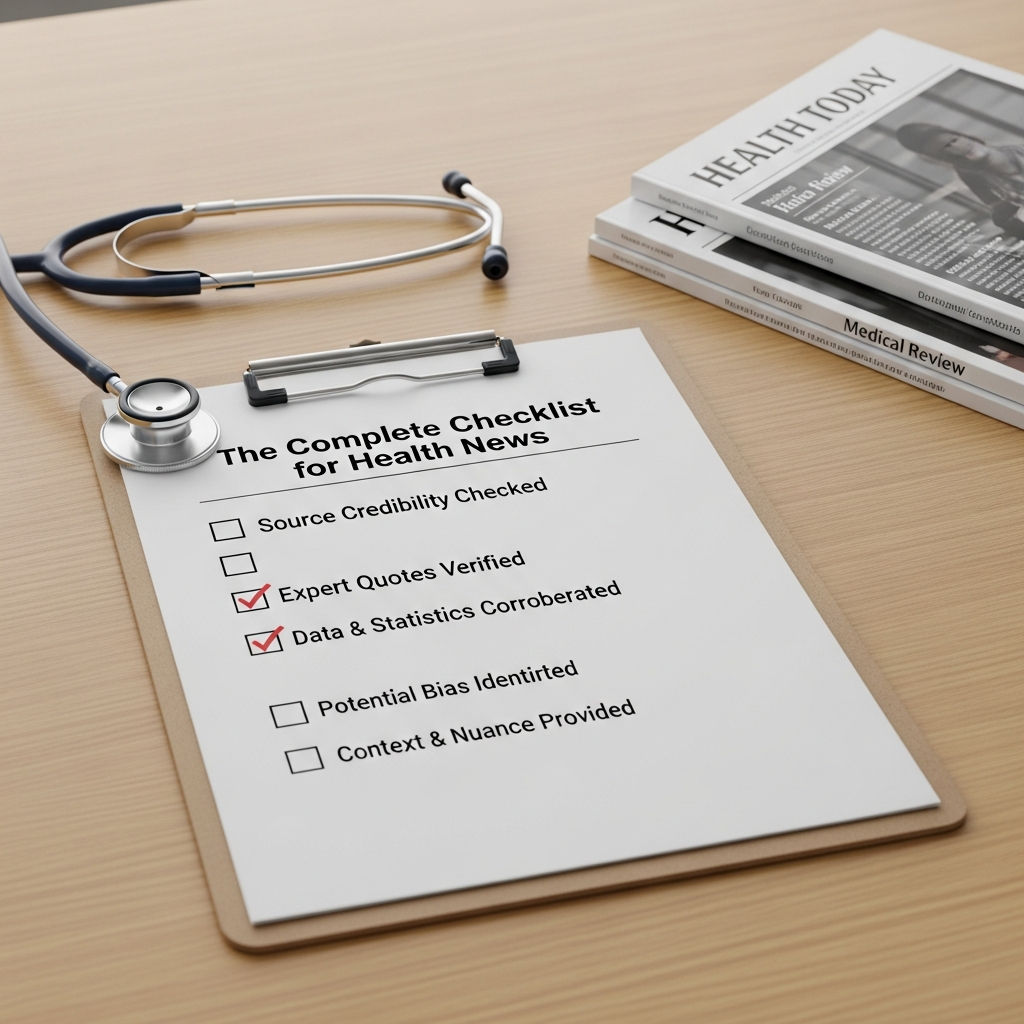
The Complete Checklist for Health News: How to Separate Fact from Fiction
In an era where information travels at the speed of light, staying informed about your health has never been easier—or more confusing. One day, a headline claims that coffee is the secret to longevity; the next, a different outlet warns it may increase your risk of heart disease. This “information overload” makes it difficult for the average person to discern what is actionable medical advice and what is merely sensationalized clickbait.
Health literacy is more than just understanding what your doctor tells you; it is the ability to critically evaluate the health news you consume online and in the media. To help you navigate this complex landscape, we have developed the ultimate checklist for evaluating health news. By using these criteria, you can protect yourself from misinformation and make better-informed decisions about your well-being.
Why a Health News Checklist is Essential
Medical science is iterative, meaning it builds upon itself slowly over time. However, the 24-hour news cycle demands “breakthroughs” and “miracles.” This misalignment often leads to the reporting of preliminary findings as if they are established medical truths. Without a systematic way to vet these stories, readers may fall prey to fad diets, unnecessary supplements, or even dangerous “cures.”
1. Evaluate the Original Source
The first step in any health news checklist is to identify where the information originated. Is the article based on a study published in a reputable, peer-reviewed medical journal, or is it citing a blog post or a press release from a supplement company?
- Peer-Reviewed Journals: Look for names like The Lancet, The New England Journal of Medicine (NEJM), or JAMA. Peer review means other experts in the field have vetted the study for accuracy and methodology.
- Secondary Reporting: If you are reading a summary on a news site, ensure they provide a direct link to the original research. If they don’t, be skeptical.
2. Understand the Study Type
Not all studies are created equal. The “strength” of the evidence depends heavily on how the research was conducted. Use this hierarchy to judge the weight of the news:
- Systematic Reviews and Meta-Analyses: These are the gold standard. They look at all available research on a topic to find a consensus.
- Randomized Controlled Trials (RCTs): These involve two groups—one receiving the treatment and one receiving a placebo. This is the best way to determine if a specific intervention actually works.
- Observational Studies: These track people over time but do not control variables. They show correlation, not causation. For example, people who eat blueberries might live longer, but they might also be more likely to exercise.
- Animal or In-Vitro Studies: Research done on mice or in petri dishes is preliminary. Humans are not large mice, and many “breakthroughs” in mice never translate to human success.
3. Check the Sample Size and Duration
A study involving ten people over a weekend is far less reliable than a study involving 10,000 people over a decade. Small sample sizes are prone to “flukes” or statistical outliers. Always look for the “n” number (the number of participants) and how long the study lasted.
4. Distinguish Between Absolute and Relative Risk
This is where health news often becomes sensationalized. A headline might scream, “New Meat Product Increases Cancer Risk by 50%!” This sounds terrifying, but it is likely a relative risk.
If the absolute risk of getting that cancer is 2 in 100, and it increases to 3 in 100, that is a 50% relative increase, but only a 1% absolute increase. Always look for the absolute numbers to understand the real-world impact on your life.
5. Look for Conflict of Interest
Follow the money. Scientists must disclose who funded their research. While industry-funded research isn’t always biased, it is a factor worth noting. For example, a study claiming chocolate improves cognitive function that is funded by a major candy manufacturer should be viewed with a healthy dose of skepticism.
6. Contextualize the Findings
No single study should ever change your entire lifestyle overnight. Science is a mosaic. Ask yourself: does this new study align with what we already know? If a new study contradicts decades of established science, it requires extraordinary evidence to be taken seriously.
Red Flags to Watch Out For
Even if an article follows some of the checklist items above, certain “buzzwords” should trigger an immediate red flag. If you see these terms used without nuance, proceed with caution:
- “Miracle” or “Cure”: Medical science rarely moves in “miracles.” Progress is usually incremental.
- “Scientific Breakthrough”: Often used to describe very early-stage research that hasn’t been tested on humans yet.
- “Doctors Hate This Trick”: This is classic clickbait designed to exploit distrust in the medical establishment.
- Universal Claims: Any health advice that claims to work for “everyone” is likely ignoring the complexities of individual genetics, environment, and pre-existing conditions.
How to Spot “Clickbait” Science
In the digital age, headlines are designed to be shared, not necessarily to be accurate. Digital publishers often use “fear-mongering” or “over-promising” to drive traffic. To spot clickbait science, look for headlines that use hyperbolic language or fail to mention the limitations of the study. A balanced health article will always mention what the study didn’t prove and what questions remain unanswered.
Questions to Ask Yourself Before Sharing
Before you hit the “share” button on social media, run the article through these four quick questions:
- Did this study happen in humans?
- Is the sample size large enough to be meaningful?
- Who paid for this research?
- Does the headline accurately reflect the actual findings of the study?
Where to Find Trustworthy Health News
If you want to avoid the noise of mainstream social media feeds, consider sourcing your health news from organizations dedicated to evidence-based reporting. These include:
- Cochrane Library: Known for high-quality systematic reviews.
- PubMed/MEDLINE: A database of millions of citations for biomedical literature.
- The Mayo Clinic and Cleveland Clinic: Reputable hospital systems that provide clear, vetted health information.
- Stat News: A journalism outlet that focuses specifically on health, medicine, and the life sciences with a critical eye.
Conclusion: Become Your Own Health Advocate
The goal of using a health news checklist isn’t to become a cynical skeptic who ignores all medical progress. Rather, the goal is to become an informed consumer. By understanding the difference between a mouse study and a human trial, or absolute risk versus relative risk, you empower yourself to have better conversations with your healthcare provider.
In the world of health news, if something sounds too good to be true, it probably is. By applying a rigorous standard to the information you consume, you can filter out the noise and focus on the health habits that truly move the needle for your longevity and well-being.